German copyright law · Urheberrecht
German copyright law (Urheberrecht) protects creators and the businesses that exploit their works. It follows the continental European author’s rights tradition and differs in important respects from the Anglo-American copyright model. This overview, written by German copyright lawyers, explains the key rules for international rights holders, licensees and users.
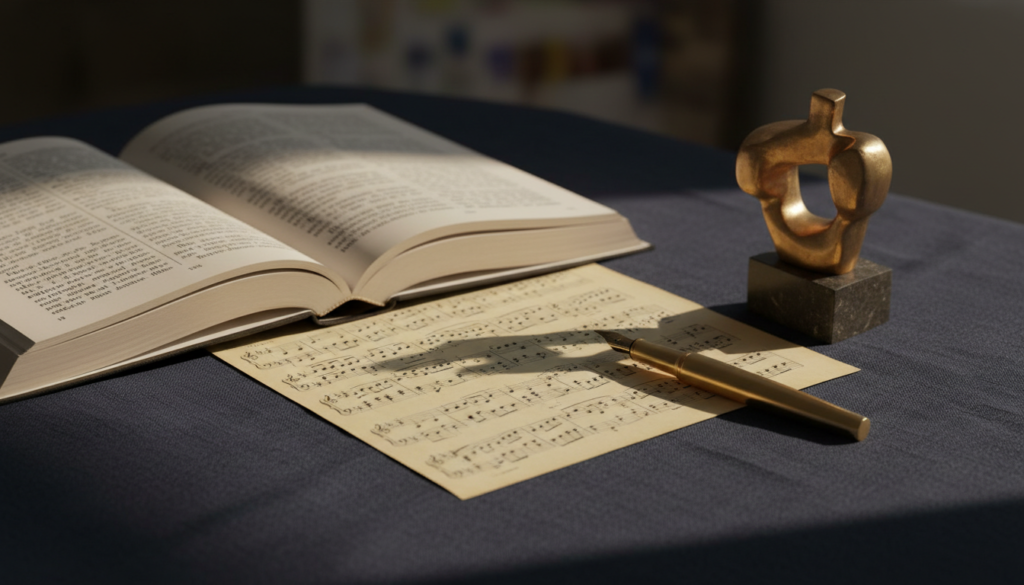
The legal framework of German copyright law
The central statute is the Copyright Act (Urheberrechtsgesetz, UrhG). It is supplemented by the Copyright Service Providers Act (Urheberrechts-Diensteanbieter-Gesetz, UrhDaG), which governs the liability of upload platforms, the Collecting Societies Act (Verwertungsgesellschaftengesetz, VGG), the Publishing Act (Verlagsgesetz) and the Art Copyright Act (Kunsturhebergesetz, KUG) on the right to one’s own image. Much of this law is shaped by EU directives, notably the InfoSoc Directive 2001/29/EC, the Enforcement Directive 2004/48/EC and the Digital Single Market Directive (EU) 2019/790, which Germany implemented in 2021. Internationally, the Berne Convention, TRIPS and the WIPO treaties ensure that foreign works are generally protected in Germany on the same footing as German works (national treatment).
Which works are protected?
Section 2 UrhG protects “personal intellectual creations” in literature, science and art, including texts, computer programs, music, choreography, works of fine and applied art, architecture, photographs, films and technical or scientific illustrations. The decisive test is originality: the work must reflect the author’s own free and creative choices. Following the case law of the Court of Justice of the European Union (CJEU), the threshold is the same for applied art and design as for other works. Ideas, styles, methods and mere information are not protected; their concrete expression is.
Protection arises automatically when the work is created. There is no registration system in Germany. Proof of authorship and date of creation therefore matters in practice – for example by depositing manuscripts, compositions or designs with a dated record.
Alongside author’s rights, the UrhG grants related rights (Leistungsschutzrechte) to performers, phonogram producers, film producers, broadcasters, database makers, press publishers and to the makers of simple photographs (Lichtbilder) that do not reach the originality threshold.
Moral rights and exploitation rights
German copyright law follows a monistic approach: personal and economic interests form one single right. The author’s moral rights (Urheberpersönlichkeitsrecht) include the right of first publication (Section 12), the right to be named as author (Section 13) and the right to object to distortion of the work (Section 14). The exploitation rights (Verwertungsrechte, Sections 15 et seq.) cover reproduction, distribution, exhibition, performance, making available to the public online, broadcasting and adaptation.
A key difference from common law systems: German copyright itself cannot be assigned during the author’s lifetime (Section 29). Instead, the author grants exclusive or non-exclusive rights of use (licences, Section 31). Under the purpose-of-transfer rule (Zweckübertragungslehre, Section 31(5)), rights not clearly specified in the contract are, in case of doubt, deemed granted only to the extent required by the purpose of the agreement. There is no general “work made for hire” doctrine; employees remain authors, although employers typically acquire the necessary rights, and for software Section 69b gives the employer the economic rights by law.
Term of protection
- Works: 70 years after the death of the author (Section 64), calculated from the end of the calendar year.
- Simple photographs (Lichtbilder): 50 years from publication or production (Section 72).
- Performers and phonogram producers: generally 70 years for sound recordings; databases: 15 years.
Limitations and exceptions, including TDM and AI
German law knows no open-ended “fair use” defence. Permitted uses are listed exhaustively in Sections 44a et seq. UrhG and include temporary copies, quotation (Section 51), caricature, parody and pastiche (Section 51a, introduced in 2021), private copying, teaching and research, and the panorama exception. Since the 2021 reform, the old “free use” rule in Section 24 has been repealed; whether a new work keeps sufficient distance from the original is now assessed under Section 23 and the pastiche exception.
Text and data mining (TDM) is permitted under Section 44b for anyone with lawful access, unless the rights holder has reserved the use in a machine-readable form for online content (opt-out). Section 60d contains a broader exception for scientific research. These rules are central to the training of AI models. Providers of general-purpose AI models must additionally comply with Article 53 of the EU AI Act (Regulation (EU) 2024/1689), including a copyright compliance policy that respects opt-outs and a publicly available summary of the training content. Purely machine-generated output generally does not qualify as a protected work, since German law requires a human creator.
Contract law and fair remuneration
German copyright contract law (Urhebervertragsrecht) protects authors and performers with mandatory rules: a right to equitable remuneration (Section 32), additional remuneration if the agreed fee is conspicuously disproportionate to the proceeds (Section 32a) and annual information rights (Sections 32d, 32e). For many contracts these rules apply even if a foreign law is chosen (Section 32b). See Licensing and contracts.
Enforcement of copyright in Germany
Rights holders can claim injunctive relief, removal, damages, information and destruction (Sections 97 et seq.). A dispute usually begins with a cease-and-desist letter (Abmahnung, Section 97a) requiring a declaration to cease and desist backed by a contractual penalty. Where urgency exists, German courts grant preliminary injunctions within days. Damages may be calculated as actual loss, infringer’s profit or a reasonable licence fee (licence analogy). Claims become time-barred, as a rule, three years after the end of the year in which the claimant learned of the infringement. Details: Copyright infringement Germany.
Frequently asked questions
Do I need to register my work to be protected in Germany?
No. Copyright arises automatically on creation. A US registration is not required for enforcement in Germany, although it can be useful evidence.
Can I buy the copyright in a work from a German author?
Not as such. You acquire exclusive rights of use, which can be drafted to be comprehensive, worldwide and for the full term. Precise drafting is essential because of the purpose-of-transfer rule.
Is there fair use in Germany?
No. Only the statutory exceptions apply, and they are interpreted in line with EU law.
Questions about German copyright law?
Call +49 511 35 73 56-0, email info@dieurheberrechtler.de or visit copylawyers.com.
Deutsche Fassung: Urheberrecht · Grundlagen